Why Snow Day Calculators Are Wrong 90% of the Time
Ever stayed up late, refreshed a snow day calculator seventeen times, and gone to bed absolutely convinced school was cancelled — only to wake up and find the bus outside your window? Yeah. We’ve all been there.
Here’s the thing — these tools feel incredibly accurate. They ask for your zip code, pull in weather data, spit out a percentage. Looks official. Feels reliable. But the truth is, most snow day calculators are little more than an educated guess dressed up in a clean interface.
So what’s actually going on under the hood? And why do they get it wrong so often? Let’s get into it.
Table of Contents
How a Snow Day Calculator Actually Works
Most people assume these calculators are connected to some powerful school district database. They’re not.
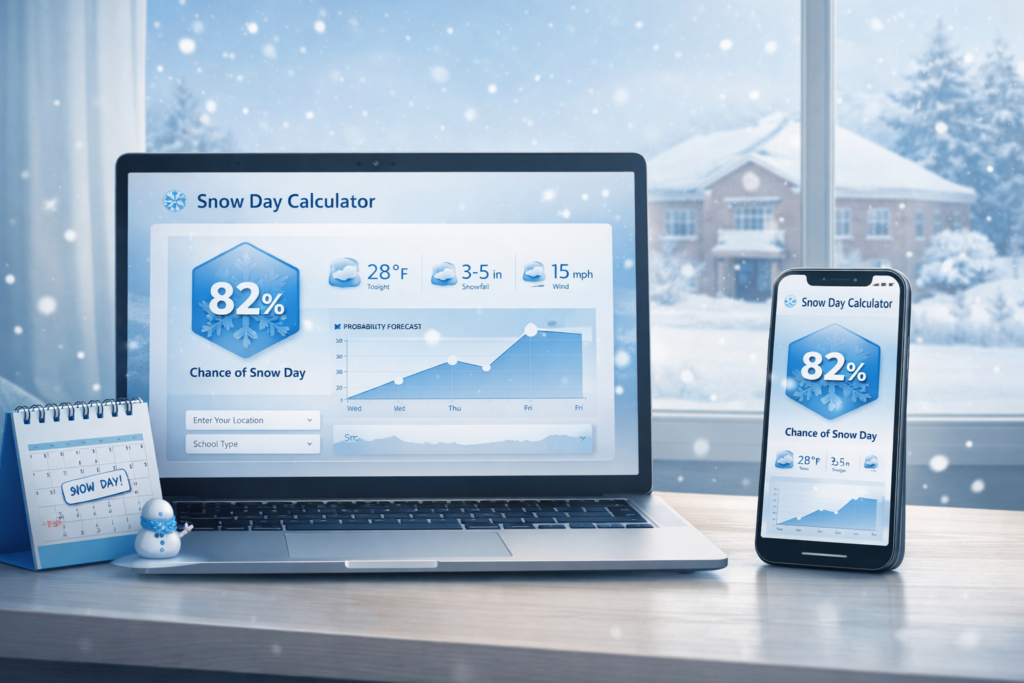
What they actually do is pull publicly available weather forecast data — snowfall predictions, temperature, wind speed — and run it through a simple algorithm that spits out a probability percentage. That’s it.
The algorithm doesn’t know your school district’s specific policies. It doesn’t know that your principal cancels school the moment there’s a light dusting, or that another district ten miles away never cancels no matter what. It’s just looking at weather numbers and making a general guess based on historical patterns.
And weather forecasts themselves — honestly, they’re not perfect either. A predicted 6 inches can turn into 2. Or 12. The atmosphere doesn’t follow rules neatly.
Why Snow Day Predictions Go Wrong So Often
There are a few reasons a snow day calculator fails more than it succeeds.
The biggest one is local decision-making. School cancellations are decided by superintendents, sometimes just hours before school starts. They factor in road conditions reported by bus drivers, staffing availability, whether the district has used too many snow days already, and sometimes — let’s be real — just gut feeling.
No algorithm accounts for that.
Timing is another problem. Snow that falls overnight looks different to a superintendent at 4 AM than a forecast made at 7 PM the evening before. Conditions change fast. A calculator built on yesterday’s forecast is already behind.
Then there’s geography. Two schools in the same county can have completely different experiences — one on a flat main road, another at the top of a steep rural hill. The calculator doesn’t know which one you go to.
What Snow Day Calculators Get Right
To be fair — they’re not completely useless.
A snow day calculator is genuinely helpful for getting a rough sense of likelihood. If it’s saying 85% and there’s a major storm incoming, yeah, there’s probably a good chance. If it’s showing 15% for a light flurry, school is almost certainly happening.
Where it fails is in that messy middle range — the 40% to 65% zone where everything feels uncertain. That’s where kids lose sleep and parents make backup plans that don’t pan out.
Think of it like a weather forecast. It’s useful directional information, not a guarantee.
| Snow Day Calculator Score | Actual Reliability |
|---|---|
| Below 20% | Pretty accurate — school likely on |
| 20% – 60% | Very unreliable — coin flip territory |
| Above 80% | Fairly reliable — good chance of cancellation |
The Secret Factors That Actually Predict Snow Days
Here’s what actually influences a cancellation that no calculator captures.
Your district’s history matters more than anything. Some districts cancel at the first sign of snow. Others — especially in northern states used to harsh winters — need a genuine blizzard. If you’ve lived in your area a while, you already have a better prediction model in your head than any website does.
Check local Facebook groups and Nextdoor. Bus drivers and school staff often live in your community. When roads are bad, word travels fast. Local chatter at 5 AM is honestly more reliable than a percentage from a website.
And superintendent Twitter or X accounts — many post updates directly. Follow yours. That’s your real snow day calculator.
Should You Still Use a Snow Day Calculator?
Sure — just don’t trust it blindly.
Use it as one signal among several. Pair it with the actual forecast, your district’s track record, and local community updates. That combination gives you a much more accurate picture than any single tool.
What I’ve found is that people who panic-check calculators every twenty minutes end up more stressed and no better informed. Check once in the evening, make a loose backup plan, and get some sleep.
The calculator is a starting point. Not a verdict.
FAQ
Q. How accurate is a snow day calculator? Most snow day calculators are accurate in extreme cases — very high or very low snowfall. In moderate conditions, accuracy drops significantly.
Q. Does a snow day calculator know my specific school district? No. Most calculators use general weather data and don’t have access to individual district policies or superintendent decisions.
Q. What is the best way to predict a snow day? Combine a snow day calculator with local weather forecasts, your district’s historical cancellation patterns, and official school social media accounts.
Q. Why did the snow day calculator say 80% but school wasn’t cancelled? Because the final decision rests with school administrators who factor in road reports, staffing, and district-specific policies — none of which any calculator can access.
Q. Are there better alternatives to a snow day calculator? Yes — following your school district’s official website, social media pages, and local news alerts is far more reliable.