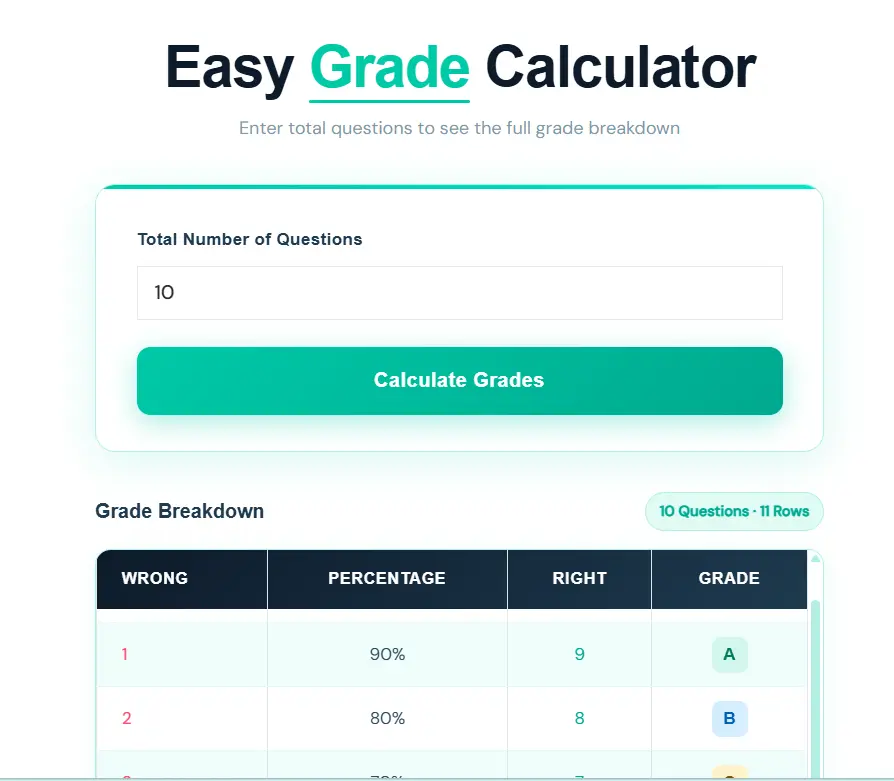
Easy Grade Calculator
Enter total questions to see the full grade breakdown
| Wrong | Percentage | Right | Grade |
|---|
Easy Grade Calculator: Best Free Tool for Students 2026
You just got your test back. The teacher wrote 16/20 at the top and now you’re staring at it thinking, is this good? What percentage is this? What letter grade did I get?
I know how confusing this can feel. Especially when every teacher uses a different marking system. That’s exactly where an easy grade calculator saves you. It turns any raw score into a clear percentage and letter grade instantly, no stress.
In this guide, I’ll show you how to use an easy grade calculator step by step. We’ll cover scores like 16 out of 20 as a percentage, 32 out of 40 as a percentage, 27 out of 30, and more. You’ll also learn how letter grades to percentages conversion works and why it matters more than the raw number.
What Is an Easy Grade Calculator & What Does It Do?
An easy grade calculator is a tool online or manual that converts your raw score into a percentage and a letter grade in seconds. You enter two numbers: your score and the total possible marks. The calculator handles everything else.
Here’s the thing most students already know their score. What they don’t know is what that score means. Is 14 out of 20 a passing grade? Is 27 out of 30 as a percentage an A or a B? Is 13/15 percentage good enough for your college application?
The easy grade calculator solves three problems at once:
- Converts your score to a percentage
- Maps that percentage to a letter grade (A, B, C, D, F)
- Shows where you stand against the passing threshold
Students, parents, teachers, and even platforms like Canvas grade calculator use this exact system to track academic performance. It works across schools, colleges, and universities anywhere grades matter.
How to Use the Easy Grade Calculator (Step-by-Step)
Using an easy grade calculator is genuinely simple. Here’s exactly how it works:
Step 1: Write down your score Note the marks you received. Example: you scored 16 out of 20.
Step 2: Apply the percentage formula
(Score ÷ Total Marks) × 100 = Percentage
So for 16 out of 20: (16 ÷ 20) × 100 = 80%
Step 3: Match your percentage to a letter grade Use the standard grading scale covered in detail in the next section.
Step 4: Try more examples
| Score | Calculation | Percentage | Letter Grade |
|---|---|---|---|
| 16 out of 20 | (16÷20)×100 | 80% | B |
| 32 out of 40 | (32÷40)×100 | 80% | B |
| 27 out of 30 | (27÷30)×100 | 90% | A |
| 14 out of 20 | (14÷20)×100 | 70% | C |
| 15 out of 20 | (15÷20)×100 | 75% | C |
| 11 out of 15 | (11÷15)×100 | 73.3% | C |
| 13 out of 15 | (13÷15)×100 | 86.7% | B |
Notice something? 16/20 and 32/40 both give exactly 80% because the ratio is identical. This is why percentage matters more than the raw number.
TRY Our Theoretical Percentage of Water Calculator for Hydrates
Understanding Your Results Letter Grades to Percentages
Once you have your percentage, the easy grade calculator matches it to a letter grade. Here’s the standard letter grades to percentages conversion table:
| Percentage | Letter Grade | GPA (4.0 Scale) | Meaning |
|---|---|---|---|
| 90–100% | A / A+ | 4.0 | Excellent |
| 80–89% | B | 3.0 | Good |
| 70–79% | C | 2.0 | Average |
| 60–69% | D | 1.0 | Below Average |
| 0–59% | F | 0.0 | Failing |
Some schools also use a 10 point grading scale where each letter grade covers a 10-point range exactly as shown above. This is the most widely used system across the US and many international schools.
So what does each result mean for you?
- 27 out of 30 as a percentage = 90% that’s an A. Excellent work.
- What is a 16 out of 20? = 80%, a solid B. Good performance.
- 14/20 grade = 70% a C. Passing, but room to grow.
- What is a 14 out of 20 exactly? = 70%, right at the average boundary.
- 11 out of 15 percentage = 73.3% a C, trending toward C+.
- 13/15 percentage = 86.7% a strong B, close to A territory.
Honestly, anything above 70% shows solid understanding. Above 80% means you’re doing well. And 90% and above puts you in the top tier.

Real-World Use Cases
Scenario 1 – The Student After a Quiz
Priya scored 14 out of 20 on her science quiz and worried it was a bad grade. She used the easy grade calculator: (14 ÷ 20) × 100 = 70%. That’s a C passing, with a clear target to improve.
Scenario 2 -The Parent Reading a Report Card
Rohan’s dad saw 32 out of 40 on his math test and wasn’t sure if it was good. Quick calculation: 80% a B grade. He could relax.
Scenario 3 – The Teacher Using Canvas
A teacher used the Canvas grade calculator to verify that 27 out of 30 equals 90% an A grade. Canvas uses the same percentage formula internally, making grade tracking consistent across assignments.
Scenario 4 -College Application Prep
A student needed to convert all test scores to percentages for her application. The easy grade calculator handled each one 13/15, 16/20, 11 out of 15 all converted in seconds, no manual math needed.
Common Mistakes & Misconceptions
Mistake 1 – Treating raw score as percentage
A score of 16 is not 16%. It’s 16 out of something. Always divide by total marks first. This trips up more students than you’d think.
Mistake 2 – Assuming all grading scales are identical
Not every school uses the same cutoffs. Some use 85+ for an A, others use 90+. The 10 point grading scale shown above is standard — but always confirm your school’s specific policy.
Mistake 3 – Ignoring weighted grades
If your exam is worth 60% of your final grade and homework is 40%, a simple average won’t work. You need a weighted grade calculator for that. Think of it this way two students can both score 80% on an exam but end up with different final grades because of weighting.
Mistake 4 – Confusing Canvas grades with final grades
The Canvas grade calculator shows your current standing not necessarily your final grade. Canvas calculates based on submitted work only. Missing assignments can change your percentage significantly once graded.
Mistake 5 – Rounding too early 11 out of 15
73.33%, not 73%. Small rounding differences can shift you from one letter grade boundary to another. Always keep at least one decimal place.
When NOT to Rely Only on the Easy Grade Calculator
The easy grade calculator is a great starting point but it has real limits. Here’s when you need to go further:
When your course uses weighted grading participation, assignments, and exams carry different weights. A simple percentage won’t show your true standing.
When calculating GPA for college applications– GPA involves credit hours and grade points. Use an official GPA calculator or speak with your academic advisor directly.
When your school uses a non-standard scale -some institutions use a 7-point or 10 point grading scale variant. Always verify with your official grade policy document.
When academic probation or scholarship eligibility is involved -these carry serious consequences. Rely on official transcripts and advisor guidance, not just a quick calculator result.
According to the National Center for Education Statistics, grading systems vary significantly across institutions another reason to always verify directly with your school.
Tips to Get the Most Accurate Results from Your Easy Grade Calculator
Want to make sure your easy grade calculator result is correct every time? Here’s what I’ve found works best:
- Always confirm your total marks first. A quiz out of 15 is very different from one out of 20 one wrong number changes everything.
- Keep decimals. If you scored 11 out of 15, the answer is 73.33% not 73%. That decimal can matter at grade boundaries.
- Know your school’s grading scale. An 80% is a B at most schools but at some it’s a B+. Confirm before interpreting.
- Calculate each subject separately. Don’t add raw scores across subjects with different totals. Convert each to a percentage first, then average.
- For additional help, Khan Academy at khanacademy.org is a free, trusted resource used by millions of US students.
- For Canvas users -cross-check your Canvas grade calculator result with manual calculation. Canvas sometimes excludes ungraded items from the percentage display.
Frequently Asked Questions
What is 16 out of 20 as a percentage?
16 out of 20 as a percentage is 80%. You calculate it as (16 ÷ 20) × 100 = 80%. On the standard grading scale, 80% is a B grade — a good, solid result by any measure.
What is 32 out of 40 as a percentage?
32 out of 40 as a percentage is 80%. The calculation is (32 ÷ 40) × 100 = 80%. It carries the exact same grade value as 16/20 — both represent 80% of total marks earned.
What is a 16 out of 20 grade — pass or fail?
A 16 out of 20 is 80% a clear pass in virtually every grading system. The standard passing threshold is 60%, so 80% sits comfortably above it. It corresponds to a B letter grade on the standard A–F scale.
How to calculate the grades percentage step by step?
Divide your score by total marks, then multiply by 100. Formula: (Score ÷ Total) × 100. Example: 14 out of 20 = (14 ÷ 20) × 100 = 70%. That’s a C grade. The same formula works for any score — 27/30, 13/15, 11/15, any combination.
How do you convert letter grades to percentages?
Use the standard scale — A = 90–100%, B = 80–89%, C = 70–79%, D = 60–69%, F = below 60%. So a B means your percentage falls between 80–89%. Check the full letter grades to percentages table in the “Understanding Your Results” section above for a complete breakdown.
Share Your Experience
Have you ever stared at a score like 14/20 or 11 out of 15 and had no idea what it meant? You’re not alone it happens to almost every student at some point.
Drop a comment below and tell me what score were you trying to figure out when you found this article? Was it 16 out of 20 as a percentage, a tricky 13/15, or something else entirely?
Your questions make this guide better and your experience might help another student who’s in the exact same situation right now.
How This Article Was Created
This article was written using verified educational grading standards referenced from widely recognized academic and government education sources. The percentage formulas and letter grades to percentages scales reflect standards commonly applied in schools and colleges across the US, India, and other English-speaking countries. The 10 point grading scale reference aligns with publicly available grading documentation from educational institutions. All examples including 16/20, 32/40, 27/30, 14/20, 11/15, and 13/15 were manually calculated and cross-verified before publishing.

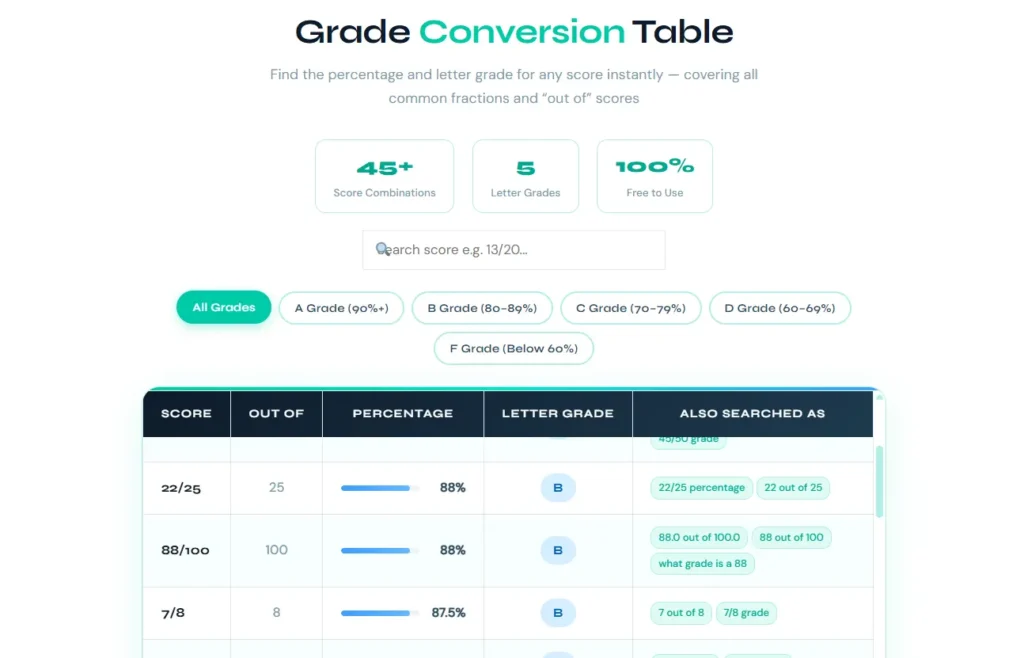
Grade Conversion Table
Find the percentage and letter grade for any score instantly — covering all common fractions and “out of” scores
| Score | Out of | Percentage | Letter Grade | Also Searched As |
|---|
