Table of Contents
Best Bitumen Calculator 2026 -Accurate Estimates in Seconds
Ever started a road or roofing project, placed your material order, and then realized halfway through you're either running short or sitting on a mountain of leftover bitumen? Yeah. It's painful, expensive, and completely avoidable. That's exactly where a bitumen calculator saves the day.
Whether you're a civil engineer, contractor, or a site manager overseeing a highway project, using a reliable bitumen calculator can be the difference between a tight budget and a financial mess. In this guide, you'll learn what a bitumen calculator is, why it matters, how to use one, and which options are genuinely worth your time in 2026.
Let's get into it.
What Is a Bitumen Calculator and Why Do You Need One?
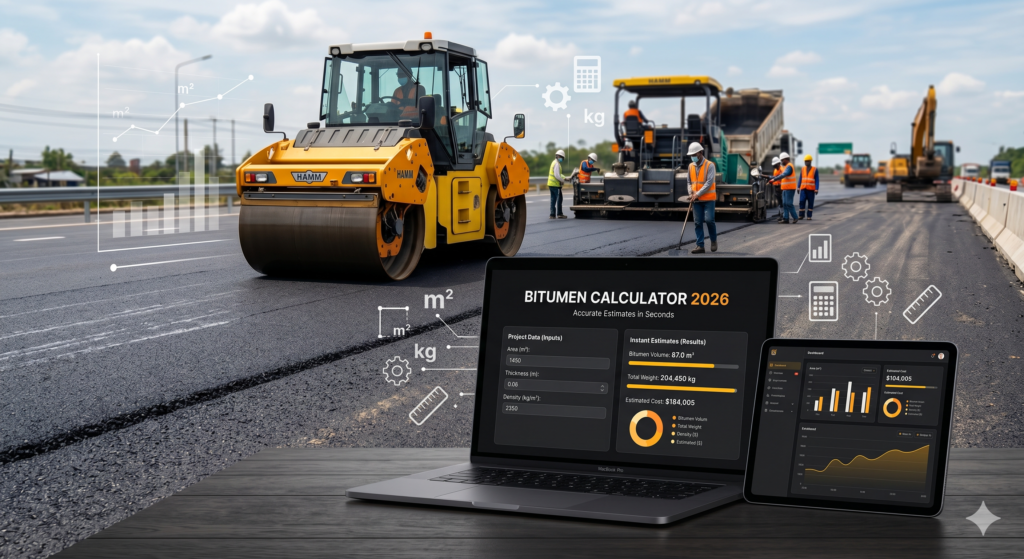
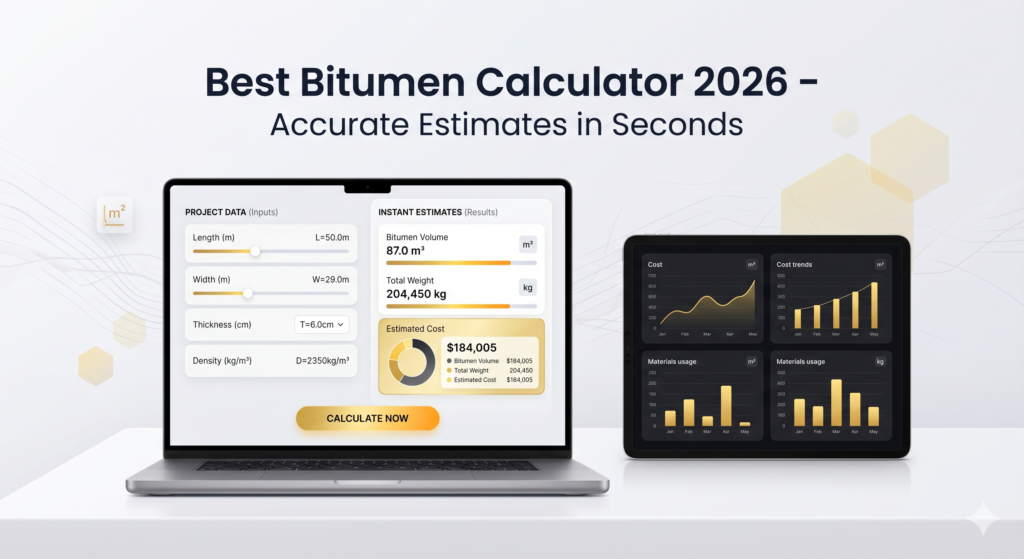
A bitumen calculator is a digital tool usually a web-based app or spreadsheet that estimates how much bitumen you need for a given surface area, depth, and mix type. You punch in a few numbers, and it spits out the quantity in liters, kilograms, or tonnes.
Simple concept. Massive impact.
Here's the thing bitumen pricing isn't cheap. In most markets, a tonne of bitumen can cost anywhere between $400 and $700 USD depending on grade and location. Even a 5% over-ordering mistake on a large road project? That's thousands of dollars down the drain.
And under-ordering? Even worse. Work stops. Workers sit idle. Deadlines slip.
That's why experienced contractors don't eyeball this stuff anymore. They calculate it. Every. Single. Time.
How Does a Bitumen Calculator Work?
The math behind it isn't complicated, but doing it manually on-site is where errors creep in. Here's what most bitumen calculators ask for:
- Surface area (length × width in meters or feet)
- Layer thickness (in millimeters or inches)
- Bitumen density (varies by mix type typically 2.3 to 2.5 tonnes/m³)
- Bitumen content percentage (usually 4%–7% of the total mix weight)
The formula looks something like this:
Bitumen Needed (tonnes) = Area (m²) × Thickness (m) × Density (t/m³) × Bitumen % in mix
For example: A 500 m² road patch, 50mm thick, with a mix density of 2.4 t/m³ and 5% bitumen content:
500 × 0.05 × 2.4 × 0.05 = **3 tonnes of bitumen**
Most online tools handle this for you instantly. You don't need to be a math wizard you just need to enter the right values.
Key Factors That Affect Your Bitumen Calculation
Not every project is the same. A bitumen calculator gives you a number but feeding it the right inputs is your job. Here are the factors that most people overlook:
1. Type of Bitumen Grade
Bitumen comes in different grades - 60/70, 80/100, VG-30, VG-40 and each has different viscosity and density. Make sure your calculator accounts for the grade you're using. VG-30 is the most commonly used grade for road construction in South Asia.
2. Ambient Temperature and Climate
Hotter climates require stiffer bitumen grades to prevent rutting. If you're working in high-temperature regions (like parts of India, Middle East, or Africa), you need to factor this into your material selection — and some advanced calculators help with this.
3. Traffic Load
Light residential roads need thinner bitumen layers than national highways. A basic bitumen quantity calculator may not ask for traffic load, but it's something you need to apply judgment on when deciding layer thickness.
4. Wastage Factor
Always add a 5%–10% wastage buffer to your calculated quantity. Spillage, material sticking to trucks, uneven spreading these things happen. A good calculator will give you the option to add a wastage percentage.
How to Use a Bitumen Calculator Step by Step
Let's walk through it practically. No jargon. Just the actual process.
Step 1: Measure your area Use a measuring tape or surveying tool. Length × Width = Surface Area in m²
Step 2: Decide on layer thickness This depends on your project type. Typical values:
- Driveway: 40–50mm
- Local road: 50–75mm
- Highway: 100–150mm (multiple layers)
Step 3: Select your mix density If you're not sure, 2.4 t/m³ is a safe default for standard hot mix asphalt.
Step 4: Enter bitumen content % For most mixes, this is between 4.5% and 6%.
Step 5: Hit calculate and review Add your wastage factor (10% is safe for most projects).
That's it. You'll have your quantity in tonnes or liters ready to send to your supplier.
Common Mistakes People Make When Calculating Bitumen
The truth is, even experienced engineers get this wrong sometimes. Here's what to watch out for:
- Forgetting to convert units - mixing meters with feet is a classic mistake
- Using wrong density - don't assume all bitumen mixes have the same density
- Not adding wastage -always account for material loss
- Ignoring multiple layers - highways often have base, binder, and surface courses; calculate each separately
- Entering total project area instead of net paved area - deduct footpaths, medians, manholes
A trusted bitumen calculator won't catch these input errors for you. That's your responsibility. Double-check your inputs before you place an order.
Bitumen Calculator for Roofing Projects
It's not just roads. Bitumen is widely used in waterproofing and flat roofing. If you're working on a roofing project, the calculation method is slightly different.
For roofing bitumen (applied hot or cold):
- Coverage rate typically ranges from 1–2 kg/m² per coat
- Most roofing projects require 2–3 coats
- Factor in the surface texture and porosity
So for a 200 m² flat roof with 3 coats at 1.5 kg/m²:
200 × 3 × 1.5 = **900 kg of bitumen**
Some roofing-specific bitumen calculators are available online. Alternatively, your bitumen supplier can provide coverage rate data for their specific product.
- Bitumen Standards – European Asphalt Pavement Association (EAPA)
- Road Construction Technical Guidelines – World Road Association
Tips to Get More Accurate Estimates
What I've found after looking at dozens of construction projects is that the calculator is only as good as your site data. Here are a few practical tips:
- Always do a site survey first - don't use approximate dimensions
- Cross-check with your supplier - they often have project-specific calculators
- Run the calculation twice - once yourself, once with a colleague
- Use metric units consistently - it reduces unit conversion errors significantly
- Keep a project log - track how much you actually used vs. estimated for future reference
That last point is underrated. Every project teaches you something. If you consistently over-estimate by 8%, adjust your wastage factor accordingly on the next one.

Final Thoughts on Choosing the Best Bitumen Calculator
Look there's no single "perfect" tool that works for every project. What matters is picking a bitumen calculator that fits your workflow, handles the inputs relevant to your project type (road, roofing, industrial), and gives you reliable output fast.
For quick estimates? A free online tool works great. For large infrastructure tenders? You'll want something more robust with the ability to save and share estimates, apply different mix designs, and generate reports.
The bottom line: stop guessing. A bitumen calculator costs nothing and saves you serious money and headache. Use it every time, for every project big or small.
FAQ Section
Q1. What is a bitumen calculator used for?
A bitumen calculator is used to estimate the quantity of bitumen required for road construction, roofing, or other infrastructure projects. It uses inputs like surface area, layer thickness, mix density, and bitumen content percentage to give you a precise quantity in tonnes or liters.
Q2. How accurate is an online bitumen calculator?
Online bitumen calculators are highly accurate when you input correct data. The accuracy depends on using the right density value for your specific mix, the correct layer thickness, and factoring in a suitable wastage percentage. Always double-check your inputs.
Q3. Can I use a bitumen calculator for roofing projects?
Yes. While most bitumen calculators are designed for road projects, you can use the same basic formula for roofing by adjusting for coverage rate per coat and the number of coats required. Some suppliers also provide roofing-specific bitumen estimators.
Q4. What bitumen density should I use in the calculator?
For standard hot mix asphalt, a density of 2.3–2.5 tonnes/m³ is commonly used. The exact value depends on your mix design. Your asphalt mix supplier or lab test report will have the specific density for your project.
Q5. How much wastage factor should I add to my bitumen estimate?
Most experienced contractors add 5%–10% wastage to their calculated quantity. For smaller or more complex projects with tight site access, go with 10%. For large, straightforward road projects, 5%–7% is generally sufficient.
Q6. Is there a mobile app for a bitumen calculator?
Yes. Several civil engineering apps on iOS and Android include a bitumen calculator feature. Apps like "Civil Engineering Calculator" or construction cost estimator tools often include asphalt and bitumen estimation modules that work offline on-site.