Asphalt Calculator – Estimate Quantity & Cost Easily
- No saved calculations
- ✅ Accurate asphalt estimation
- ✅ Supports multiple units (meters/feet, inches/cm)
- ✅ Easy to use for contractors & engineers
- ✅ Density customization & real-time cost

If you’ve ever stood in front of a freshly dug driveway and thought, “How on earth do I figure out how much asphalt to order?” — you’re not alone. Underordering means a second delivery fee. Overordering means wasted money sitting in a skip. This guide walks you through the exact math, a live calculator you can use right now, and every practical detail you need before your project begins.
What Is an Asphalt Calculator?
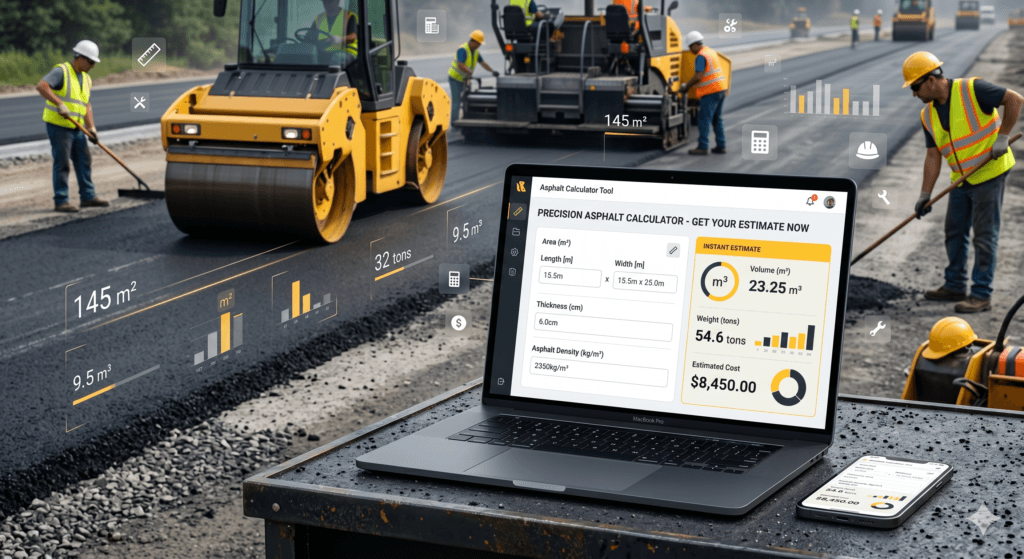
An asphalt calculator is a tool — either online or on paper — that takes three basic inputs (the length, width, and thickness of your paving area) and tells you exactly how many tons of asphalt mix you need to order. It removes the guesswork that leads most homeowners and contractors into costly ordering mistakes.
Whether you’re repaving a residential driveway, a parking lot, or a small access road, the underlying math is identical. The only thing that changes is the density of the asphalt mix you’re working with — and we’ll cover that in detail further down.
The Formula Behind the Calculation
Most people assume this is complicated. It really isn’t. Here’s the core formula that every professional paving contractor uses:
Weight (tons) = Volume × Density of Asphalt (typically 145 lbs/ft³)
All-in-one shortcut: Tons = (L × W × T × 145) ÷ 2000
Where length and width are in feet, thickness is also in feet — so 3 inches = 0.25 ft — and 145 lbs/ft³ is the standard density for hot-mix asphalt. The 2,000 in the divisor simply converts pounds into US short tons.
Free Asphalt Calculator
Enter your project dimensions below. The calculator handles all unit conversions and gives you the estimated tonnage — including a recommended buffer — instantly.
Asphalt Quantity Estimator
How Thick Should Your Asphalt Be?
Thickness is not a one-size-fits-all number — it depends entirely on what load the surface needs to carry. Using too thin a layer is one of the most common reasons asphalt fails within a few years. Here’s a reliable reference:
| Application | Recommended Thickness | Notes |
|---|---|---|
| Pedestrian paths & walkways | 1.5 – 2 inches | Light foot traffic only |
| Residential driveways | 2 – 3 inches | Standard car and SUV weight |
| Parking lots | 3 – 4 inches | Regular vehicle turnover |
| Local / residential roads | 4 – 6 inches | Mix of cars and light trucks |
| Commercial / heavy-traffic roads | 6 – 8+ inches | Trucks, buses, constant use |
Always check with a local contractor if you’re unsure. Soil conditions and climate — especially areas with hard freeze-thaw winters — can push recommended thicknesses upward significantly.
Types of Asphalt and Their Densities
Not all asphalt is the same product. The mix you choose affects both the density you plug into your calculation and the long-term durability of the surface. Here’s a quick rundown of the most common types:
| Type | Density (lbs/ft³) | Best For |
|---|---|---|
| Hot-Mix Asphalt (HMA) | 145 | Most driveways and roads — the industry standard |
| Dense-Grade Mix | 148 | High-traffic surfaces needing extra durability |
| Warm-Mix Asphalt (WMA) | 143 | Lower emissions, good for eco-conscious projects |
| Porous / Open-Grade | 140 | Drainage-sensitive areas, reduces runoff |
| Cold-Mix Asphalt | ~140 | Temporary repairs and patching only |
If your contractor hasn’t specified a particular mix, default to hot-mix asphalt at 145 lbs/ft³. That’s the right assumption for the vast majority of residential and light commercial projects.
Pro Tips to Avoid Costly Mistakes
Even with the right numbers in hand, there are a few practical things that can make or break a paving job. These come up again and again:
📐 Measure Irregular Shapes Properly
Break any non-rectangular area into smaller rectangles, calculate each section separately, then add the totals together. Don’t try to eyeball a curve.
➕ Always Order a Buffer
Order 8–10% more than your calculated figure. Edge work, uneven spreading, and small waste during compaction will always eat into your total.
🌡 Watch the Weather
Asphalt must be laid when ambient temperatures are above 50°F (10°C). Cold ground causes poor compaction, leading to premature cracking and surface failure.
🏗 Don’t Skip the Base Layer
A properly compacted gravel base (sub-base) is what gives asphalt its long-term load-bearing strength. Skimping here is the number one reason driveways fail early.
💧 Plan Your Drainage
The finished surface should slope at least 1–2% away from buildings and structures. Pooling water softens asphalt and dramatically shortens its lifespan.
📦 Check Minimum Order Quantities
Most asphalt plants require a minimum delivery of 2–5 tons. For small patches under 50 sq ft, cold-mix bags from a hardware store are usually the more practical choice.
Estimating Your Total Project Cost
Once you know your tonnage, cost estimation becomes much more straightforward. Asphalt prices fluctuate with oil prices and vary by region, but here’s a reliable general framework to work from:
| Cost Component | Typical Range (USD) |
|---|---|
| Asphalt material (per ton) | $80 – $160 |
| Delivery and hauling | $50 – $150 flat fee |
| Grading and base preparation (per sq ft) | $0.50 – $1.50 |
| Labour and installation (per sq ft) | $2.00 – $5.00 |
| Sealcoating — optional but recommended (per sq ft) | $0.15 – $0.35 |
For a typical 20 × 50 ft residential driveway — roughly 18 tons — a complete installed cost generally lands somewhere between $3,000 and $7,000 depending on your location, the condition of the existing base, and whether old material needs to be removed first. Always collect at least three quotes from local paving contractors before signing anything.
Frequently Asked Questions
This article is intended for estimation purposes only. Final material quantities should always be confirmed with your asphalt supplier or paving contractor. Prices and densities vary by region and mix design specification.